


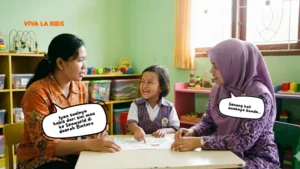
Parental Reflection: Tips for Early Childhood Development and Bonding – Why is parental reflection crucial for a child’s development, especially those still in early childhood education? Early childhood education is a fundamental period that determines a child’s future.
This phase is often referred to as the golden age, during which 80% to 90% of brain development occurs before a child reaches the age of six.
In this context, parents, as the first and primary educators, have a moral responsibility to constantly reflect on the parenting patterns they provide.
The goal? Of course, to optimize the natural development of their children.
Early Childhood Development and the Importance of Parental Reflection
The growth and development process in early childhood is not limited to physical achievements, but encompasses broader aspects, namely mental, social, and spiritual. Reflection for parents is crucial so that we do not get caught up in unrealistic expectations, which can actually trigger psychological pressure on children.
Regular reflection allows parents to review whether the education provided meets the emotional needs of their child or is merely limited to fulfilling material needs.
Research in the Dzurriyat Journal (2024) confirms that parents’ emotional mastery in reflection significantly affects children’s ability to regulate their own emotions.
Thus, reflection is not merely an evaluation of values, but an effort to be a wise role model for children in interacting with their environment.
What Should Be Evaluated in Early Childhood Development?
Parents’ reflections and comprehensive evaluations should cover various areas of their children’s development. First, parents need to pay attention to the development of religious and moral values.
This can be observed from simple habits, such as honesty, caring for others, and performing daily prayers as instructed.
Second, physical and motor aspects, which include physical health and motor skills. Parents must monitor whether their child’s gross motor coordination (running, jumping) and fine motor coordination (holding writing instruments, buttoning clothes) are appropriate for their age.
Third, the cognitive and critical reasoning domains are another important point of evaluation. Children who are developing well cognitively will show a high level of curiosity, be able to recognize patterns, and have good literacy skills.
Finally, evaluation of the social-emotional aspect should not be overlooked. At the early childhood education age, children are expected to be able to manage negative emotions, show empathy, and be able to work together.
The Importance of Bonding from an Early Age
In addition to parents’ reflections on their child’s growth and development, emotional attachment is a long-term investment in the child’s mental health. In psychological studies, secure attachment is key to a child’s self-confidence and independence.
Research published in the Journal of Obsession (2025) reveals that a strong bond between mother and child has a positive effect on the child’s resilience in facing obstacles.
This proves that emotional closeness is not a factor that makes children spoiled, but rather provides a sense of security.
It is also important to emphasize the role of fathers in the bonding process. Active involvement from fathers provides different but complementary stimulation to mothers, especially in building problem-solving skills.
Finally, it is important to understand that in today’s digital age, the biggest challenge in building bonding is the phenomenon of technoference, where the distraction of gadget use can reduce the quality of parents’ emotional presence in front of their children.
Therefore, giving undivided attention without screen distractions is an urgent need in order to maintain the emotional well-being of children.
Read Also: Why Are Schools in Finland Bullying-Free? Here Are 5 Secrets Indonesia Can Emulate
How to Build Bonding with Early Childhood Education Children
Building meaningful bonds does not always require expensive activities. Parents can apply the following practical strategies:
- Family creative activities: For example, involving children in a project to make trash cans from used items. This activity can stimulate the imagination while providing moments of warm physical closeness.
- Giving traditional toys: Games such as bakiak have a special value that can foster solidarity across generations.
- Responsive communication: Set aside special time for in-depth dialogue and ask questions to encourage your child to open up.
- Consistently practicing the “7 Habits of Great Indonesian Children,” such as waking up early together, can shape positive character traits while strengthening family bonds.