How to Safely Use AI with Kids: The Fun of Creating Art & Stories! – Hello, Moms and Dads! Just take a moment to think about how fast technology has been advancing lately. It feels like just yesterday we were learning how to use touchscreen smartphones, and now the whole world is buzzing about Artificial Intelligence.
Maybe when you first heard the term “AI,” what came to mind were super-smart robots or complex computer programs used only by adults for work. That’s totally understandable—many parents feel worried at first.
But did you know that, when guided properly, this technology can become an amazing play-and-learning companion for your little ones?
Lately, the trend of using AI for children has been gaining attention from education and parenting experts. It’s not meant to make kids lazy thinkers, but rather to unleash their imagination to levels we’ve never imagined before.
Imagine if your little one’s random scribbles could turn into beautiful digital paintings, or their short hums could be transformed into full-fledged songs. That’s so exciting, isn’t it?
In this article, we’ll thoroughly discuss why artificial intelligence is so important for supporting your little one’s learning process in the modern era especially in the fields of visual arts, music, and storytelling. Grab some snacks, and let’s dive in!
Why Is the Use of AI for Children Becoming Increasingly Important in the Learning Process?
The world of education is constantly changing. Back when we were in school, a smart child was often judged by how well they could memorize lessons. But for our children, who were born as Generation Alpha, memorization skills alone are no longer enough.
In a future filled with automation, the most sought-after skills are creativity, problem-solving, and adaptability. This is where the importance of smart technology in children’s learning process lies.
First, AI helps bridge the gap between imagination and technical ability. Often, children have incredibly grand ideas in their heads, but their tiny hands aren’t yet able to draw or play a musical instrument as beautifully as their imagination envisions. This can sometimes frustrate them and eventually lead them to give up. With the help of AI, that barrier crumbles. Children can immediately see their ideas come to life, which naturally boosts their self-confidence.
Second, AI teaches children about cause-and-effect logic and computational thinking. When interacting with an AI program, children must provide instructions (often called prompts). If the instructions are unclear, the results will not meet expectations. This process of trying, refining the instructions, and observing the results is a highly valuable form of problem-solving practice.

Related Post




So, using AI with children is really about empowering them to become the “directors” of their own imagination, rather than merely passive consumers who just stare at a gadget screen.
Exploring Boundless Creativity Through Visual Art
Let’s move on to the most fun part: fine arts or visual arts! Almost all children love to draw and color. This is the most natural way for them to express their emotions and tell stories before they can write fluently.
Unfortunately, a child’s fine motor skills sometimes don’t keep up with their imagination. For example, your little one might say, “Mom, I want to draw a purple cat that can fly with dragon wings and wear sunglasses in outer space!”
If drawn with crayons, the result might just be a bunch of purple circles. But with the help of AI image-generation apps (like Bing Image Creator, Midjourney, or specialized educational apps for kids), that wild imagination can come to life right on the screen!
So, what do children learn from this process?
- Vocabulary Development: To generate good images using AI, children must learn to describe their ideas in detail. Parents can prompt them with questions like, “How big is the cat? Is its fur soft or coarse? What color is the outer space?” This greatly helps build children’s vocabulary.
- Appreciation of Color and Composition: When the AI-generated image appears, children can observe the harmonious blend of colors. They indirectly learn about aesthetics, lighting, and artistic composition.
- Inspiration for Physical Artwork: Don’t stop at the digital screen. Once the AI-generated image is complete, parents can print it out and then encourage their child to trace it onto paper, color it with real watercolors, or turn it into a wall decoration for their room.
AI is not a replacement for sketchbooks and crayons. AI serves as a catalyst for ideas, inspiring children to be even more enthusiastic about creating with physical materials.

Becoming a Young Composer: Making Music with the Help of AI
In addition to visual arts, music is an excellent universal language for developing children’s emotional and cognitive intelligence. Just listening to music is great—and it’s even better when children can create their own music!
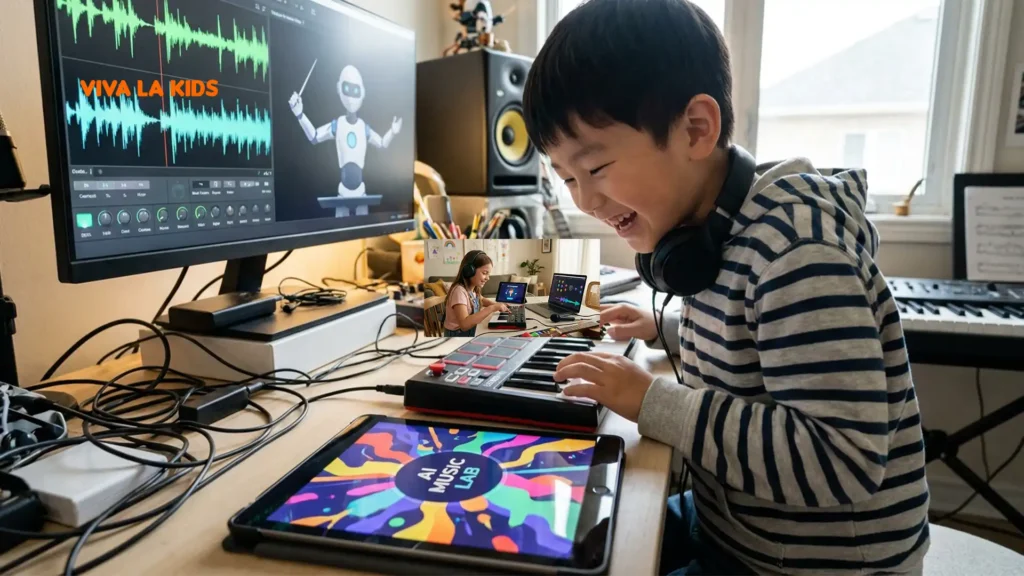
Typically, to compose a song, someone must take years of piano or guitar lessons and learn to read sheet music. Of course, traditional music lessons are excellent and still highly recommended. However, AI technology now allows children who haven’t yet mastered a musical instrument to still become “little composers.”
There are many child-friendly AI-based music platforms. Through these platforms, children can experiment with all sorts of things.
How does it work, and what are its benefits?
- Exploring Genres and Instruments: Children can choose the mood they want for their song. For example, “I want to make a cheerful song with drums and a flute.” The AI will put it together. Through this, children learn to recognize the differences in the sounds of musical instruments and various music genres (such as pop, classical, or jazz).
- Understanding Rhythm and Beat: Some apps let children hum a random melody, and then the AI will refine the pitch so it’s in tune. This trains children’s pitch perception.
- Expressing Feelings: Music is closely linked to emotions. When your little one is sad because a toy is broken, Mom and Dad can invite them to create a “Sad Song” using AI. This is a very healthy form of emotional healing and recognition that supports their psychological development.
Sparking the Imagination by Weaving Magical Stories
Storytelling is one of the oldest and most effective parenting methods for instilling moral values. Text-based AI (such as ChatGPT or Claude) can be an incredibly fun writing assistant for children.
Instead of Mom and Dad reading fairy tales from existing books, how about creating your own fairy tale with your little one tonight?
It’s very easy to do. Mom or Dad can sit with your little one on their lap and open the AI app. Ask your little one to decide on the main elements of the story. “Who’s the main character, sweetie?” “A bear!” “What’s his name?” “Bubu!” “What’s Bubu going to do next?” “Bubu wants to find honey, but he’s afraid of bees.”
Next, type the following prompt into the AI: “Write a short children’s story about a bear named Bubu who wants to find honey but is afraid of bees. Include a moral lesson about courage. Use cheerful language that a 5-year-old can easily understand.”
In a matter of seconds, the complete story will appear. What are the extraordinary benefits of this process?
- Fostering a Love of Reading: Children will be much more enthusiastic about reading or listening to stories because they feel they’ve played a part in creating them. They feel a sense of ownership over the story.
- Learning Narrative Structure: Over time, children will come to understand that a story must have a beginning (character introduction), a middle (problem/conflict), and an end (resolution). This lays the foundation for logical and systematic thinking.
- Building a Bond: The question-and-answer process that shapes the story’s plot between parents, children, and the AI is a precious moment of quality time. You can laugh together when the AI comes up with a funny or unexpected plot twist.
Tips Aman dan Praktis Dampingi Anak Bermain AI
Of course, the use of any technology must be accompanied by parental guidance. The use of AI by children will have the greatest positive impact if it is done with the right guidance.
Here are some tips that moms and dads should definitely follow:
- Full Supervision (Co-Viewing & Co-Playing): Do not let toddlers or elementary school-aged children explore AI on their own. Parents should be the ones in control of the device (typing or pressing buttons), while the child provides the ideas. This prevents children from being exposed to age-inappropriate content.
- Focus on the Process, Not the Result: Remind your child that while a great image or song generated by AI is cool, the thought process and ideas behind it are what matter most. Praise their imagination, not the computer’s sophistication.
- Set Screen Time Limits: Screen time rules remain strictly in effect. Treat these AI play sessions as a special activity, such as 30 minutes on the weekend. Don’t let AI replace your child’s time for physical play outdoors, exercise, or socializing with peers.
- Connect It to the Real World: As discussed earlier, use AI creations as a stepping stone. Stories generated by AI can be acted out as a puppet show in the living room. Images created by AI can serve as inspiration for coloring with crayons.
Conclusion: AI as an Assistant, Not a Replacement
Ultimately, parents don’t need to be afraid of technological advancements. The use of AI by children won’t stifle their creativity; on the contrary, this technology will open wide the doors to a world of boundless imagination.
Read Also: Playing Lego Duplo World to Develop Children’s Fine Motor Skills and Logical Thinking
Art, music, and storytelling are the three main pillars for nurturing a child’s sensitive, perceptive, and creative spirit. By using AI as an assistant—not as a replacement for parents or teachers—we’re equipping our children with a high level of adaptability to face the future. They’ll not only be tech-savvy, but also emotionally mature and brimming with brilliant ideas.
So, are you ready, Mom and Dad, to take your little one on an adventure and create something spectacular this weekend?
Come on, share in the comments below what idea you’d like to try first with your little one using AI! Do you want to draw a purple dragon, or write a song about morning baths? We can’t wait to hear your exciting stories!