





Is Your Child Short? Recognize the 5 Symptoms of GHD (Growth Hormone Deficiency) – Have you ever felt worried when you saw children the same age as your little one who seemed much taller at school? Or perhaps you often hear relatives ask, “Why is your child so small? Are they not eating enough?”
Don’t worry—every child has a different growth phase. However, sometimes a height that’s significantly below average isn’t just a “genetic factor,” but a medical sign that needs attention. One of these is GHD (Growth Hormone Deficiency).
What is GHD, and how can you tell it apart from naturally slow growth? Let’s discuss this in detail.

What Is GHD in Children?
Simply put, GHD is a condition in which the pituitary gland (a small gland at the base of the brain) does not produce enough growth hormone to help a child grow to their full potential.
If left untreated, this condition will certainly affect the child’s adult height.
However, not all short children have GHD. That is why parents need to be aware of the more specific symptoms.
5 Symptoms of GHD to Watch Out For
Here are some signs that parents should watch for at home:
1. A Drastic Slowdown in Height Growth
Children typically grow at a certain rate each year. If you notice that your child’s height has barely increased over a period of 6 months to 1 year, this is a major red flag.
Pay attention to whether your child is still wearing the same clothes or pants for an extended period of time.
2. Below the 3rd percentile on the growth chart
Pediatricians typically use growth charts to monitor a child’s development. If a child’s height consistently falls below the 3rd percentile compared to their peers, it’s advisable to seek further consultation.
3. A Face That Looks Younger Than Their Age
One of the distinctive features of GHD is a facial appearance often described as cherubic. Children with GHD may have round faces with a somewhat flat nasal bridge, making them appear younger or like toddlers even though they are already quite old.
Read Also: The Foundation of Optimal Child Health: A Comprehensive Guide to Nutrition, an Active Lifestyle, and Digital Well-being
4. Delayed Tooth Eruption
GHD affects not only the long bones in the legs and arms but also dental development. If a child’s primary or permanent teeth erupt significantly later than the normal timeline, this can be an indicator of a hormone deficiency.
5. Fat Accumulation Around the Abdomen
Because growth hormone also plays a role in fat metabolism, children with GHD often have a more compact body build with little fat accumulation, particularly in the abdominal area, even though their appetite is not excessive.
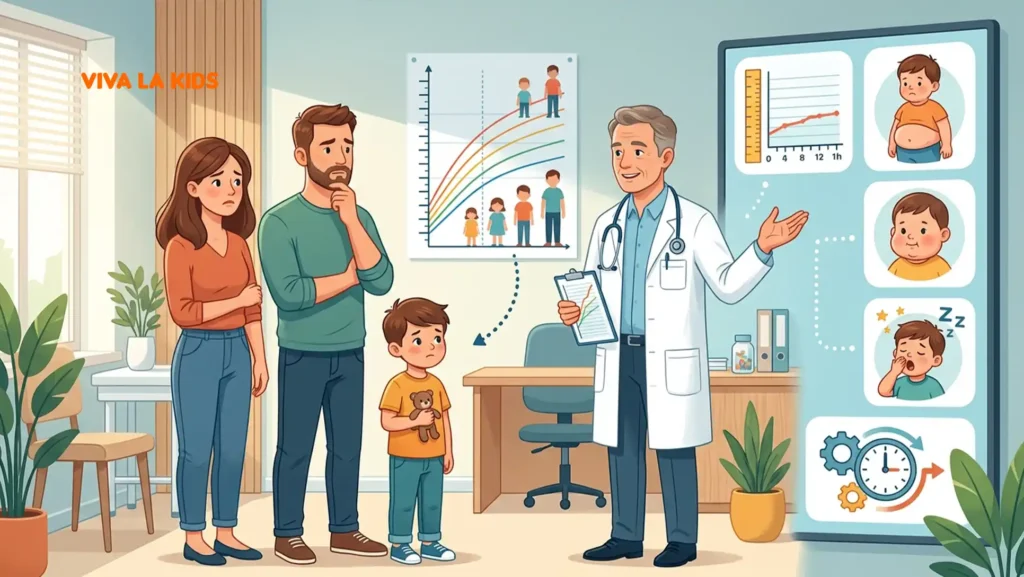
When Should You See a Pediatric Endocrinologist?
If you notice two or more of the symptoms listed above, don’t panic. The wisest course of action is to take your child to a pediatric endocrinologist.
The doctor will conduct a thorough examination, starting with reviewing the medical history, performing blood tests to check IGF-1 levels, and conducting a growth hormone stimulation test if necessary. Remember, early detection is key. The sooner it is detected, the greater the chance that the child will receive the appropriate hormone therapy (somatropin) so they can still reach their maximum height potential.
Don’t compare your child to other children too much. Focus on your child’s own growth curve. If you have any concerns, consult a medical professional.
Conclusion
Monitoring your child’s growth is the best way to show your love. If your child has been diagnosed with GHD, don’t lose heart. Modern medicine has made great strides in helping children with GHD grow just like other children.
No Comment! Be the first one.