




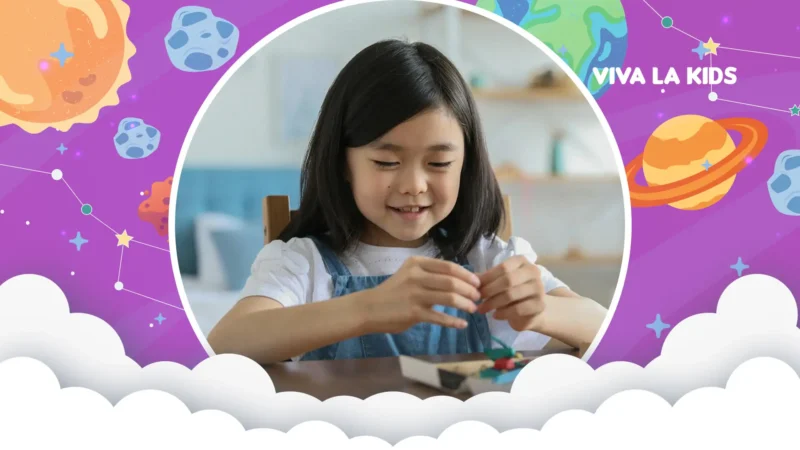
The Importance of STEM Education in Educating Today’s Children – STEM is an acronym for Science, Technology, Engineering, and Mathematics. The disciplines encompassed by this field have a tremendous impact on society.
The use of Artificial Intelligence (AI), for example, is becoming increasingly widespread. The same is true for innovations in environmentally friendly energy and advancements in applied mathematics.
Unfortunately, STEM or science and technology is often stigmatized as a difficult field of study. As a result, many children feel reluctant to study these subjects.
To address this, it is a good idea for parents to provide their children with a science and technology education from an early age.

The Benefits of STEM Education for Children
Children will reap tremendous benefits when parents introduce them to STEM education from an early age.
Here are some of the benefits of studying this field for your child.
1. Children Can Develop Critical Thinking Skills
Critical thinking skills are essential for preparing for the future.
By studying topics in science, technology, and mathematics, children can develop these thinking skills from an early age.
For example, when learning about photosynthesis, parents can help children practice analyzing natural phenomena in a holistic way.
Similarly, when learning about different types of food, children can practice distinguishing between healthy and unhealthy options.
2. Encouraging Children to Innovate
Children will also learn to innovate from an early age by studying STEM. This is because STEM is the most innovative field compared to other disciplines.
In the future, children’s ability to innovate will be extremely helpful.
This is especially true if your child has an interest in entrepreneurship or wants to work in the Research and Development department.
3. Preparing for It Through School Lessons
Another benefit of STEM education for children is that it prepares them for school. There’s no denying that subjects like science and math can be challenging.
However, if children already have a solid foundation of knowledge, their learning difficulties will be reduced.
4. Improving Collaboration Skills
When learning STEM, parents can have their children learn in a group. If your child is an only child, there’s no harm in parents taking on the role of a teammate.
Create a simple yet engaging project to work on together. For example, building a model of a mountain or a windmill.
In addition to improving their thinking skills, children will also learn how to work well together in a group.
5. Improving Technology Literacy
In today’s digital age, technological literacy is essential. By studying science and technology, children will develop strong technological literacy and understanding.
They will not only become consumers of technology products but will also understand how each product works, as well as its strengths and weaknesses.
STEM Education for Children Should Be Fun
Parents play a vital role in helping children who want to learn science, engineering, technology, and mathematics.
Parents must dedicate their time, provide resources, and share their knowledge so that children can learn these disciplines from an early age.
However, it is important to emphasize that STEM education should never be forced upon children. Coercion can cause stress, which ultimately undermines what they have learned.
Various studies, such as those conducted by Sue B. Whiting and colleagues, confirm this. Parents should provide learning at home using fun and engaging methods.
Read Also: 5 Ways to Help Children Develop Emotional and Communication Skills
For example, instead of asking children to memorize the names of chemical elements, parents can encourage them to create fun mnemonic devices.
The same applies when children are learning about seed germination. They can conduct hands-on experiments by planting flower seeds rather than simply memorizing the process.
Such approaches will make STEM education more enjoyable for children and less mentally taxing.
No Comment! Be the first one.